Showing posts with label Philosophy. Show all posts

Friday, January 5, 2018

For When You Need A Little Refresh

Is January kind of hard for anybody else?

All the beautiful lights and decorations came down at my house two days ago, and things are looking a little bare.  

If you're anything like me, I bet you spent the holiday season planning.  And anticipating.  And sometimes having a huge adrenaline rush when you realized that those last minute Christmas presents WEREN'T ACTUALLY WRAPPED YET! 

In fact, it's possible you hustled so much during the holiday season that you're not even sure how you felt about it, because you were too busy to stop and wonder.  I've been there.

But each year, as the children grow older, I'm gaining the courage to say "no" to the holiday traditions that don't bring us joy.  And that gives us time to slow down and delight in the things we love - the candles, the lights, the carols and smells of the season.

Even the most ordinary moments seem guilded with a warm glow of firelight.  


For just a few short weeks, all those special traditions we've been anticipating for 12 months are front and center in our lives.  I find myself saying "yes, let's!" so much more often than normal, instead of "not right now," or "I'm too busy."


And then, in the blink of an eye, all the fun is over, the party guests have gone home, and you're left with piles and piles of clean-up.  And maybe a stomach ache from all those treats.


No wonder January can feel a little blue.  A little cold.  A little dreary.


But in this season of endings and new beginnings, can you feel the forward motion toward spring?  The days are lengthening, the sun is showing its bright face (sometimes), and putting away Christmas decorations and obligations gives us a fresh start, a kind of blank canvas in our homes that we can either fill or leave blissfully empty.

And after several years of quiet, I'm quite excited to give this blog a fresh start.

In the coming months, I'm excited to share with you the things that I'm learning and the things that are inspiring me.  It would be a sad thing indeed if I were the same person I was three years ago, and I think the blog needs to reflect that.  I'm looking forward to sharing more inspiration, more encouragement, and a little bit less "eat only real food or you're a pathetic schmuck"-type judginess.  

Now, what about you?

What are you looking forward to this year?  What are you struggling with?  What is getting you excited?  And what would you like to see more of here on ye ole blog?

Sunday, October 20, 2013

The Dirty Secret at the Heart of My Mommy Blog

People blog for all kinds of reasons:

  • To keep faraway family and friends updated on their lives
  • To share their brilliant ideas with others
  • To make some money to support their families


I have, at various times, blogged for all of those reasons.  When I first started this blog, I thought I could take a unique stance on typical mom issues, or look at domestic issues from a nerdy point of view (the only one I had at the time).  

However, I quickly realized that "the rest" of the blogs out there like mine were drawing traffic with recipes, gorgeous pictures of food, and DIY tutorials.  Big, fat, long posts full of numbers and mathematical symbols were not exactly a selling point.  So I started doing what everyone else was doing: taking food pictures of my new recipes, writing DIY "how-to's," and recording my new discoveries for the benefit of others.

But here's what I gradually learned: I found that (what?!) actually living my life, being fully immersed in it with no camera in my pocket, was so much  more fulfilling than constantly blogging about it.  I hate dragging a camera down to the garden all the time, and I especially hate making my family wait to eat dinner so I can take a picture of their food first!  

But here's the most important thing I discovered during those months: I was blogging because I felt like I was doing so much around the house that was of value, that was significant, and that I wanted SOMEONE, ANYONE to see and admire.  

Do you see the problem here?  I think this is secretly at the heart of so much of the current mommy blog obsession.  We work so hard in our homes, we pour out our hearts in the things we are doing, but who recognizes our hard work?   

So here we are, working our tails off, and who is there to notice but God?  And I found myself thinking, "I better take a picture of this so it can go into a blog post, because otherwise, it's just extra work, unnoticed and wasted."  

This was my dirty secret: I felt unappreciated, unnoticed, unpraised.  And I wanted someone to tell me, "Great job!  You've done something that matters!  Society's only message to me was, "you are of value only if you make money to buy nice things."  And so blogging became my source of recognition, of pride, of value.  

But that is not my true source of value.  My worth doesn't come from other people recognizing my hard work.  It doesn't come from doing the work.  It doesn't even come from the character that is gradually built up in me as I put my own desires on the shelf to provide for my family.  Nope.  My value is deeper than that.

I am loved, cherished, valued by the One who made me.  

Always, forever, and regardless of what I accomplish during the day. 

That is the truth I needed to fill up the empty discontent in my soul.  And when it is filled up, daily, by knowing who I am and Who He Is, then instead of striving and working to fill myself up, the things I do are an overflow of the love that is full to the top within me.

Monday, October 7, 2013

Controlling Asthma Naturally Update - What Works for Me


When we moved from Oregon to Colorado 2 years ago, one of the first things I noticed was that my asthma started acting up.  Switching to Real Food years ago had gotten it under control for about 3 years without prescription meds, but when we got here, the humidity, pollen, whatever, made it really flare up again.

Especially during the spring and fall, even if I didn't have "classic" allergy symptoms like runny nose or itchy eyes, I would have shortness of breath, wheezing, coughing, and all the old asthma symptoms returned with a vengeance!

So, as I shared 2 years ago, I've been exploring different natural options to control my asthma without prescription medications.  


Here is what works for me:

  1. A foundation of healthy fats. 

    They keep me full and drastically reduce blood-sugar swings.  By healthy, I mean fats from real foods, like butter, coconut oil, lard, olive oil, fatty fish.  I absolutely avoid ALL cheap, processed oils like canola, soy, vegetable, sunflower, etc.  These oils come from factories, not food!


  2. Plenty of (safe) starches and carbs. 

    For me, this means potatoes, white rice, sweet potatoes, starchy/carby vegetables, and occasional non-gluten grains.  If I don't eat them, I don't feel full, and I have low energy.  But I make sure I eat them with plenty of fat, or else they do spike my blood sugar.
     
  3. Avoiding (most) gluten.

    Some people do fine with a little wheat.  I generally don't, and many other asthmatics are in the same boat.  If I eat it, I have asthma symptoms, period.  I still occasionally do, like in social settings where it would be rude or awkward to refuse (after all, it doesn't make me hurt...just wheeze), or on a special occasion, like my kid's birthday cake (give me a break, those bean cakes on Pinterest are NOT good enough to give to guests).  I have noticed that good sourdough white bread bothers me the least of all wheat products, so if we do have wheat, we try to have it in that form.
  4. Avoiding pasteurized dairy.  

    We still drink raw milk and eat yogurt, cheese, kefir, and sour cream with no problems.  Also, I have no trouble at all with pasteurized heavy whipping cream - I drink it in my tea every morning.  But milk from the store is out, as are ice cream, hot cocoa mixes, etc.  If I do have to eat these things, or just really, really need a little scoop of ice cream to make me feel human, I try to eat it with some raw milk or fermented dairy to help it digest more easily.  For me, this is almost as big a trigger as gluten.
     
  5. Plenty of Fat Soluble Vitamins. 

    We take Cod Liver Oil somewhat regularly (a molecularly distilled type with synthetic Vitamins A and D added), eat high-vitamin foods like egg yolks, liver and oily fish, and I've started taking a D3 supplement.  I know some experts are against supplementing, but, honestly, I just can't feed my kids sardines at every meal when we go to a play date and they are offered PB&J's.  We already eat weird food, I don't want them to have complexes.  So we supplement a little bit to help cover those dietary gaps that come from being socially graceful.  For me, I've noticed a pretty big improvement in my asthma since adding in the Vitamin D supplement.
     
  6. Good Bacteria.  

    I try pretty hard to eat something fermented every day, whether that is yogurt or kombucha or homemade fermented veggies or Bubbie's pickles, or whatever.  Also, we spend a TON of time outside playing in the dirt, working in the garden, petting the filthy dog even after he swims in the muddy pond, mucking the chicken coop, and we are NOT fastidious about washing our hands.  My 1-year-old has eaten more dirt than I thought possible this summer.  Permaculture has reminded me (sorry, I had to throw in at least one reference to it), that the microbial health of the soil is what supports the health of plants, and in turn, of bugs and larger animals that eat those plants.  The closer we are to our healthy soil, eating produce from it and exposing ourselves directly to it, I think the healthier we will be.
  7. Careful Exercise.

    When I was younger and had time to jog, I noticed that regular running helped my asthma stay under control.  Basically, if my cardiovascular health was good, then "normal" life exercise didn't make me breath hard, so didn't bother me.  However, going for an hour run everyday made me tired and really made one of my hips hurt.  So my exercise now consists of working hard around the yard, doing jobs around the house, hefting kids/feed bags/tools around, and doing body-weight exercise like squats, push-ups, core, and yoga poses.  And if I feel like sprinting after my kids, dashing up to the garage to grab a shovel, or flying down a particularly tempting hill, I go for it.  When I listen to my body and run when it feels like running, I get some great sprints in, I have no trouble with my asthma, plus I enjoy every minute!  I feel invigorated and think, "I love sprinting places!" instead of feeling like a dead dog and thinking "Jogging is necessary torture."  Mark Sisson's 5 Essential Movements and Primal Blueprint Fitness E-book gave me a good start, although I take it more easy than he suggests, since I'm still nursing and notice a milk shortage when I overdo it.
     
  8. Natural Remedies.

    I will preface this by saying, I still use my albuterol (rescue inhaler) occasionally, sometimes in the thick of allergy season when working in the garden or if I have a bad cold.  Also, if I have eaten dairy or wheat, I tend to be wheezy by evening.  Breathing is important, not something to mess around with, and you don't want to end up in the emergency room or morgue, so don't hesitate to take action if you (or your kid!) are about to asphyxiate!  However, when I'm just feeling a little wheezy or tight in my lungs, I often try some natural remedies instead of reaching for the inhaler.  A hot shower with plenty of steam helps relax my lungs.  Also, if I have annoying wheezing and can't sleep, but it's not bad enough to really cause distress, often a cup of hot tea helps ease the wheezing enough for me to drift off.  Along with that, eating cold foods sometimes makes wheezing worse, so I try to avoid that if I'm having a rough time of it.  I have heard everything from garlic to ginger to turmeric to lemon juice can help ease symptoms, but if you are eating tons of trigger foods and filling your body with inflammation-causing crud, a spoonful of turmeric is not an adequate long-term solution!  These remedies work best if you are already doing the hard work of changing your diet and improving your health.

    A Little More Background About How I Got Here:

I considered putting myself on the GAPS diet, which is a gut-healing regimen that basically (as I understand it) tries to repair micro-holes in the large intestine by only allowing foods which digest in the small intestine.  This means most starchy foods are eliminated, like grains, uncultured/pasteurized dairy, most beans, all refined sugar.  And probiotics are gradually introduced, so that good bacteria can replace bad bacteria in the gut, further healing any damage.

There are many things I love about the idea of the GAPS diet:

  • It is all real food.  Made in your own kitchen.  
  • It emphasizes healthy fats (saturated from pastured animals).
  • It uses traditional cooking methods, like long simmering of bones to make nutrient-rich broth.
  • It eliminates many of the "problem foods" that I had noticed were aggravating to my asthma, like pasteurized milk and wheat.
However, since the GAPS diet has been so widely used in the past few years, I started finding many testimonials from people who had tried it and had issues with it.  According to these people, it really is amazing at doing what it claims - improving those "Leak Gut Syndrome" symptoms.  But it can also lead to fatigue, thyroid issues, and low body temperatures for some people.  In particular, one of my favorite bloggers, Sarah at Nourished and Nurtured, recorded her family's GAPS journey in detail.  She eventually decided that if she could do it over again, she would not have started the GAPS diet with her family, partly because of the problems it caused, and partly because it is just so much work for what it accomplishes.  

So, my next question was, "If not GAPS, then what?"  I gradually stumbled across Matt Stone and Chris Kresser and their "revolutionary" advice to listen to your body, experiment, and see what works for you and what your body is really craving (from more carbs to more sleep to less exercise!).  I also have really enjoyed the Perfect Health Diet, which is kind of a Paleo spin-off (like Chris Kresser) that encourages eating plenty of "safe starches."


So, that's the run-down of what has helped me, every day, to control my asthma naturally, without prescription medicine.  I still keep a rescue inhaler handy, but I have been able to avoid using preventative prescription medicines for 5 years now and counting!


Note: I'm not a doctor or nutritionist or anything licensed.  Please don't interpret my personal experiences to be medical advice, and check with your doctor before discontinuing any medicine, blah blah blah legal jargon.

Do you know anyone who suffers from asthma?  Have they had any luck trying to control it with natural methods?  What has been helpful for them?  Leave a comment and share your experiences and thoughts!

Posted at Small Footprint Friday and Fat Tuesday

Saturday, May 25, 2013

Does Location Determine Eating Habits?

I am absolutely blown away by how productive my little raised bed garden is so far.  Since the kids helped (over)plant tons of greens, yesterday it was my mission to clear out a little of the bounty.  You know, so the other plants could actually get a little sunlight!  I headed to the garden, pulled a little bit of this and a little bit of that, and left with the garden looking barely touched.  

And I harvested a huge basket of green abundance:


You may have heard me mention before (like 10 or 15 times...) how easy it is to grow things here in Oregon.  If you will, compare the above basket of overflowing greens with the puny radishes below:  


Those radishes, plus about 4 little lettuce leaves, were my harvest in Colorado.  All of it.  For a whole year.  They represented hours of building, hauling soil, and watering.  And I was so, so proud of them!  My harvest the year before consisted of three carrots about as large as my pinky.

So what made the difference?  Yes, I learned a lot in the intervening years about soil, deer, water, etc.  But for me, the biggest difference was just location.  Even knowing all that I know today, the thought of trying to garden at 9000 ft. in the Rockies if we ever move back fills me with absolute dread.  To use my best Old English, I have seen the goodness of this land, and I am loth to depart from it.

The amazing fertility of this area makes it so much easier to find local food to make up a high quality diet.  Grass-fed cows roam every hillside, wild salmon teem in the river (and peoples' freezers), half my friends keep chickens for eggs, and I can get pastured poultry from the little town where we go to the library.  It is just SO easy to eat well here, and it was SO much harder in the area where we used to live.  

When we were first getting started in our real food journey and discovering things like grass-fed meats, raw milk, and locally grown produce, I was often so overwhelmed and discouraged by how hard it was for me to find the things I wanted to be able to eat!  Raw milk meant a 2-hour drive every week, the only grass-fed poultry I could find was 150 miles away, and even our local farmer's market had to import produce and pastured meat from over a hundred miles away.  There was no local cheese, no local butter, no delicious local bacon to be had in grocery stores.  I don't think I ever saw a cow laying down contentedly on a hillside in my area...the few I saw were always roaming voraciously, trying to find enough growing stuff to stay alive! 

I remember reading other peoples' experiences of buying all their quality animal products in one place at a cute little local farm, or finding amazing produce at roadside stands in the summer, and I felt like the odds were stacked against me because of my location!  I even once, in frustration, asked a blogger how I could be "expected" to eat anything but grocery store meat without spending a fortune, and was basically told, "thousands of families are making it work, surely you can too, if you just try a little harder."  

Okay, I may be writing this to let off long-suppressed frustration (hey, you are the one still reading this, don't blame me...), but also to remind others in the real food community that just because they live in a place where real food is easy to come by, does not mean it is just as easy for everyone!  

When you get all wrapped up in and sold on this real food thing, it's sometimes easy to think, "Once you know that it'll make you feel so much better, why in the world wouldn't you eat well?  What could be holding you back?"  My frustrated voice is calling from 2 years ago, saying, "Keep encouraging me!  Don't judge me!  It's frickin' hard to find good food where I live!"

If you are frustrated by the local food situation where you are, I so understand, and I encourage you to keep seeking, keep asking store owners to stock good things, and keep instigating positive change in your community!  Or just move to Oregon.  

What is the food environment like where you live?  Are you ever frustrated because you can't access the things you'd like to be able to eat?  Or are there a lot of like-minded real food eaters in your community?  What can people stuck in relative "food deserts" do to find what they need?


Wednesday, February 6, 2013

Feel Happy in 4 Minutes

And now, to cheer you up if you recently read about how Mars, Coca Cola, and McDonald's are sponsoring the American Dietetic Association,

please, go and watch the shameless tearjerker that is "The Man Who Couldn't Walk."  I promise, you will be happy and motivated after you watch it, unless your heart is made of iron ore.

Do you want to go work out now or what?!

Should Coca Cola, PepsiCo, and Mars Sponsor the American Dietetic Association?

Aren't we supposed to trust Registered Dietitians?  There's no way nutrition or dietetic associations would be swayed by the influence of "Big Food" industry giants, is there?

I may have a good answer for that question, and it involves (surprise!) money.

Eat Drink Politics (which is author Michele Simon's website dedicated to "Countering Industry Harm to Improve Public Health,") recently released a very thorough report about the corporate sponsors of the Academy of Nutrition and Dietetics (the new name for the American Dietetic Association).

The report's main point is that notorious industry giants (like Coca Cola, McDonald's, and Nestle) are influencing the Academy of Nutrition and Dietetics (or AND), mainly through direct advertising at Academy conventions and "continuing education" courses sponsored by particular companies.

I strongly encourage you to at least browse through the summary of the report (see the tab "Executive Summary" on the Eat Drink Politics' home page).  Although it appears that many Registered Dietitians (RD's) do not approve of some of the corporate sponsors, these huge companies are still in a position to drastically influence the opinions of the dietitians who attend AND events.

Some of the more disturbing items in the report:
  • Coca Cola and other companies can pay to conduct "continuing education" seminars at the AND's annual conference, where they, among other things, defend the safety of sugar and aspartame consumption for children and claim that the federal guidelines for school lunches are really too restrictive (what?!).
  • At the AND's annual conference, the expo hall (you know, the big room where you can wander around and sample things from the corporate sponsors) was dominated by "big food" companies, while tiny booths with real food representatives were squeezed into corners and along the edges.
  • Since these companies are sponsors of the AND, they can put its logo on their products, along with proud claims about how they are partnering with the AND to help support healthy lifestyles.  I'm sure you can picture that kind of label on a box of cereal - this report paints a vivid picture of what that corporate sponsorship actually looks like from the perspective of RD's.
Now, dietitians are intelligent grown-ups who are free to make their own choices about whether McDonald's is really a "healthy choice" for children.  But this type of ridiculously blatant corporate manipulation helps explain the dire health of our nation today.  Dietitians receiving "continuing education" from Coca Cola?  And we wonder why we can't beat childhood obesity?

Fortunately, the report lays out some very clear suggestions for the AND, which, if followed, could drastically improve the credibility of the organization.  In the meantime, please share this information!  In ethical health and nutrition, as in so many things, the first step toward recovery is admitting that you have a problem.

What do you think about "Big Food"'s influence on dietetics and nutrition?  Do you think removal of these corporate sponsors might possibly urge the AND toward accepting more Traditional Food/Real Food values?

Posted at Simple Lives Thursday, Healthy 2day Wednesday, Your Green Resource, Frugal Days, Sustainable Ways, Thank Your Body Thursday, Fresh Foods Wednesday, WFMW, Fight Back Friday, Small Footprint Fridays

Thursday, January 10, 2013

Homemade Elderberry Syrup for Cold and Flu


Problem: 

Most over-the-counter cold and flu medicines are for "kids 6 and older" or "4 and older," and the only thing I found at my local drugstore for children 1 and over was honey "cough syrup."  Really, that's all it was.  Honey and water, and preservatives.  "Hmm," I thought, "Thanks, but no thanks, I seem to recall having honey at home in my kitchen..."

Solution:

So what is a concerned mother to do when her whole posse of kids who are NOT "6 and older" is in the midst of cold and flu season?  Why, make Elderberry Syrup, of course!

Elderberry, traditionally called "the country person's medicine chest," has been used medicinally since ancient times.  It contains anti-inflammatory anthocyanins, compounds which can help relieve nasal or chest congestion.  But its real claim to fame is in fighting the flu.  In studies done in Israel in 1993 and 1996, an Elderberry remedy was proven 99% effective at fighting flu viruses.  And honey (the other main ingredient in the syrup) has been proven just as effective of a cough suppressant as dextromethorphan (which is in most over-the-counter cough syrups).

I say "make" elderberry syrup, not "buy," because 4 ounces of this stuff will set you back more than $12 at my local store.  Plus, it may contain delightful additions like Xantham Gum and "mango, raspberry and cherry flavors."  What?  Do I really need mango flavor added to my kid's berry syrup?  


So, instead of paying over $12 for 4 ounces, I made 32 ounces of elderberry syrup for about $5.  

For the discount-savvy among us, that's like a sale sign that says, "93% OFF!"  

Plus, my version contains only water, elderberry juice, and honey.

Here is the recipe, as adapted from the version at Modern Alternative Mama:
(Note!  This is only for children OVER 1 year old!*)


Homemade Elderberry Syrup

Ingredients:
4 cups water
1 cup dried elderberries
1 cup honey (I used 1/2 raw and 1/2 normal)

Directions:
1. Combine dried elderberries and water in a saucepan. 

2. Heat to a boil over medium heat, and boil for 2-3 minutes. 

3. Turn off heat and let steep for an additional 10-15 minutes.  

4. Strain out berries, and allow remaining juice to cool to room temperature (or at least less than 118 degrees if you want the honey to stay "raw"!), and then stir honey into elderberry juice. 

5. Store in quart size container in the refrigerator.  According to the expert, this will keep in the fridge for a month or two (the honey acts as a natural preservative).


So, where do you get dried elderberries?  Well, apparently, there are some on a bush up the road from my house if you want to swing by in early August...  yeah, I didn't get mine there either (I didn't know what they were used for in August).  I got mine on Amazon because Mountain Rose Herbs was sold out.  Apparently, I'm not the only one interested in making elderberry syrup!  

My elderberries came in a lovely 1 lb. package.

1 cup is about a quarter of the package, so I should be able to make syrup 3 more times from this batch.

Since it's not a good idea to give honey to baby Euclid, I made him a separate batch with no honey, and froze it in ice cube trays so I can defrost it a week at a time or so.  

*A word about the age restriction: Even if you boil the honey in the syrup instead of adding it later, you should not give this stuff to babies under 1.  Honey can contain botulism spores, which an infant's stomach is not equipped to deal with.  Boiling is notoriously ineffective against botulism spores (hence the need for pressure canning some items at extra-high temps), so your open saucepan on the stove won't kill the suckers.  Maybe there is a safe temperature to pressure cook honey at to make this safe for babies, but I don't know, don't want to risk it, and since Euclid will be force-fed this stuff with a syringe anyway, I don't care if it is not super sweet (it's not horrible without honey, just has a shorter shelf life). 

Saturday, November 17, 2012

6 Reasons to Eat Fat

Goodbye, 80's and 90's.  The low-fat craze is officially over (but leggings are back?).  Here are my 6 favorite reasons to eat healthy, life-giving fats!

source: flickr

1.  Fat is Delicious.

   Let's face the facts here.  Anything cooked in butter is better.  Anything containing bacon is better.  Nearly   anything topped with a cream-based sauce is better.  Cooking with fat is one of the best ways in the world to make your food taste outrageously AMAZING!!  Just ask Julia Child.
  I have a theory that more Americans would cook their own food (and really enjoy it!) if they would cook with plenty of fat.  It really makes a world of difference in the taste, and it helps alleviate the desire to eat out all the time.  And eating more home-cooked meals means you can control what kind of fat you're eating, rather than getting whatever the restaurant cooks decided to use (often whatever is cheapest).  

2. Fat Helps Even Out "Sugar Highs" and Lows

   Since I have gotten really intentional about making fat a consistent part of my diet, I have noticed that I rarely have huge energy "crashes" like I used to.  You know that kind of queasy, ravenous feeling you sometimes get after drinking juice or eating sugary candy?  It is mysteriously absent when plenty of fat is consumed as well.  This is because the fat helps the contents of your stomach (including that sugary food) digest a bit more slowly, so it's not flooding your bloodstream with glucose quite as quickly.

3. Fat Helps You Feel Fuller Longer

   You hear a ton these days about fiber and protein, and how they magically keep you full for a long time so you can stick to your super healthy diet.  Okay, I am not denying that.  But fat is the most underrated stomach-filler of all time.  Haven't you ever complained about "that meal that is just sitting like a brick in my stomach...I feel like I'll never need to eat again?"  Chances are, it was a fatty meal.  So we all know intuitively that fat helps us feel full and satisfied, but we are so pumped full of fat-phobia that we don't take advantage of that knowledge.  Instead, we put ourselves on a high-carb insulin roller-coaster, wondering why we are always hungry an hour after eating!  Just add some healthy fat to what you eat, and you'll feel fuller much longer.

4.  Fat Helps Your Body Absorb Vitamins

   Not all vitamins.  Just the fat-soluble ones.  That would be good ole' A, D, E, and K.  Fat-soluble means these 4 vitamins don't dissolve in water, only in fat.  So having adequate fat in your diet helps your body get enough of 'em.  And, interestingly enough, it is these very vitamins that are seriously lacking in modern diets, especially when compared to diets of healthy traditional people of the past.  
   As luck would have it (just kidding), foods that contain fat also tend to contain these vitamins.  Think real dairy (skim doesn't actually qualify as dairy in my book), egg yolks, and animal products like liver.  So all those dietary advisers who say "it really is good to put dressing on your salad to help you absorb its nutrients" are absolutely right.  Now if only they would remind everyone to put butter on their cooked veggies...  

5. Fat is Not the Devil

   Okay, let me amend that statement... real fat, fat created as nature intended, is not the devil.  I'm not advocating Crisco and soybean oil here (or anything else dissolved, bleached, and deodorized in a factory).  But coconut oil, butter and full-fat dairy (preferably from pastured animals), lard, tallow and schmaltz (with the same pastured condition), high quality olive oil, have gotten some seriously undeserved criticism from the low-fat crowd.  
   Yes, fats do contain 9 calories per gram, instead of 4, like carbs and protein do.  But do they make you fat? Do they clog up your arteries?  Do they give you heart attacks, acne, and heartburn?  The evidence against healthy fats, my friends, is seriously lacking. 
   Even "mainstream" nutritionists (read: not fringe "Natural Health" nuts like myself) are now admitting that some fats are good for you (like the "Mediterranean Diet" kind - Extra Virgin Olive Oil seems to be above reproach in all nutritional circles), and recent research is finally vindicating high fat dairy, as well.  Cholesterol is being increasingly understood as a critical component of a healthy body, and even the "artery clogging" saturated fats in coconut oil and animal products are gaining popular acceptance.  

6. Healthy Traditional Diets Are Fatty

  People have been eating fat for millenia.  It has worked out pretty darn well thus far.  Oh, until the last 50 years or so.  Strange how as America's consumption of butter, whole dairy, and other real, natural fats have gone down, our rates of obesity, heart attack, stroke, and other "lifestyle diseases" have skyrocketed.        

What's your favorite fatty food?  Do you generally try to eat "low fat," or avoid any specific types of fat?  Leave a comment below and share your views on the fat debate!

Posted at Monday Mania, Gluten Free MondayHearth and Soul, Tasty TuesdayTeach Me TuesdayFat Tuesday, Real Food Wednesday, and WFMW

Thursday, October 11, 2012

Because a Joyful Heart is Good Medicine

Melissa the Dyno-mom - one of my favorite bloggers - and her (10!) children compiled a hierarchy of meat deliciousness the other day, and it was just too funny not to share.

Monday, October 8, 2012

Fun with White Flour

We have some flour in the cupboard that's been feeling pretty ignored lately.  Yeah, all the super motivational healthy eating people say that you should always clear all the junk food out of your house when you are dedicated to eating healthfully.  But I always have to wonder: do they go to potlucks?  Do they have normal-eating friends over?  What do they serve them?  

Confession: I am not opposed to whipping up a batch of normal chocolate chip cookies when when we have a house full of guests.  I am not going to convince them that they should join me in my food insanity by serving them nasty coconut flour cookies (and, sorry, I still haven't found a grain-free cookie that is anywhere near delicious).  We don't use white flour regularly for our own family meals.  But it is not like I'll be hanging out one evening, craving something sweet, and think, "Hey, I'll just go have a spoonful of flour," so I consider this a pretty safe staple to have around the house in case I need to make something quick and cheap for someone else.

Side Note: This activity, when used with toddlers, WILL make a mess, unless you hover over your children the whole time.
Side Note #2: Did you know (I only found out a year or two ago), that people with Celiac disease can sometimes have reactions to gluten that just touches their skin, or that they breath?  Scary stuff!  

We poured just enough flour into a pan to coat the bottom.  I made it thick enough so the kids could smooth it out into a layer to "erase" the marks they made in it.


Little Miss Euler basically just smashed the flour around, and made a few little shapes.  My personal favorite, "I'm going to draw a rainbow for Daddy!  A black rainbow..."


 But Einstein was really focused on smoothing it out, then drawing and writing in it.  We practiced all our letters that we've learned so far, and he was way more interested in the process than usual.  He is not a huge fan of messy hands, so we started out using the eraser end of a pencil to write.  Then, once he saw how much fun Miss Euler was having, he joined in the chaos, and they both ended up basically coated in flour from the waist up.


Even Baby Euclid got in on the action (he is going through a not-putting-stuff-in-his-mouth-that-much phase right now, so I was okay with him playing this way).

There may also be homemade play-dough in our future, to help the rest of the flour not feel so neglected.  I also have a box of whole wheat penne in the cupboard that's just begging to be made into some kind of pasta craft.

If you've ever started eating differently, did you purge the kitchen of all junk food first?  Do you serve different kinds of foods to guest, or at potlucks, than you and your family eat everyday?

Monday, September 17, 2012

New Chicken Run! Quality Craftsmanship

My husband finished the chicken run!  Our poor little hens can now run around outside, munch the grass, and feel the sun on their feathers.


You can kind of see the little door from the coop to the run.  The gateway from chicken hell to chicken heaven.


 The kids and chickens have been getting some extra exercise the last few days.  I think it is good for the chickens to be chased a little to help them stay in shape and learn to run from predators... right?

You may notice the lovely 4x4's and sturdy gate.  My husband's doing.  He loves building stuff, and his family did some ranching/farming when he was growing up, so it comes pretty easily to him.  He made this run to last.  

Sometimes it's hard for me to allow him to invest the time and/or money to do things right the first time.  I love spending as little as possible on everything I do, but I am gradually learning (partly because of being married to this particular man) that in many cases, you really do get what you pay for.

I don't mean organic rice cakes that come in at $15.00/lb. 

I mean the $30 cast-iron skillet that will still be in great shape in 300 years, rather than the $5.00 Teflon cheapo that you will have to toss next year.

In our disposable society, where many of us shop just for entertainment, sometimes it's much harder to purchase a high-quality product than a cheap one.

When do you think it's worth it to spend a little more and get a high-quality product, and when do you like to save and pay the bare minimum?

Posted at Barn Hop


Friday, September 14, 2012

Learning Play for Preschoolers

The other day I told you a little (or a lot...) about how we are working on Einstein's preschool skills at home this year in preparation for kindergarten (at home or at school) next year.  

We are insanely relaxed in our daily schedule (especially during the summer, and especially since the baby was born), so right now we're focusing less on the content of what we learn and more on the process of doing some specific activities at more set times during the day.  

Most of these activities are way too easy for Einstein (4) and just about right for Miss Euler (2 1/2), but this way Einstein can feel like he's helping out.  Also, Einstein has a much more cautious, deliberate personality, and when he's being introduced to something new, he needs to feel successful or he gets discouraged and either gives up or starts goofing around.  So having some easier things to do right now are helping build his confidence, I think, and just helping him enjoy the routine of learning in a slightly more structured way.  

I've been finding fantastic ideas for activities in many places.  While I don't necessarily agree with every aspect of the Montessori method, there are a ton of very hands-on "Montessori" learning ideas out there, and we've been using a few of them.  I've enjoyed Montessori Home-School (monthome.com) because it has a ton of ideas (with pictures!) of activities.  Many of the activities require special equipment (much of it homemade), but we've gleaned a few great ideas that can be easily prepared with items commonly found around the house.  Here are just a few:

Using different sized spoons, ladles, and strainers to scoop small beads out of a bowl of water


Eating with chopsticks (no tofu here, though).  This one was pretty tricky and quickly devolved into just poking the cheese with the chopstick like a skewer.

We do practice the alphabet with these magnets, but we've also been playing "what's metallic in our house?"

And I've been finding magnets all over the place...

I was having so much fun with this one that I forgot to take pictures, but we tested various objects' buoyancy in water, then talked about where to "graph" them on our picture.  This one made me SO excited for when the kids are old enough for "real" graphing... I'm so nerdy.

This is a little hard to see, but we set up a dish washing station on some chairs and the kids helped me wash some things.  I'm not sure why I never thought of this before, but they loved it and it was genuinely helpful.
 

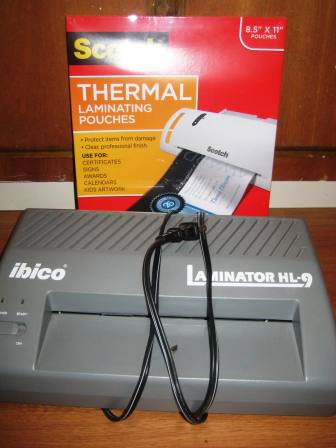
Okay, this is my secret shame.  I discovered this beast out in my husband's office and splurged on laminating sleeves (they are quite pricey).  So I am being careful to conserve my laminating resources...


This is what the laminating is for.  This particular set is from Confessions of a Homeschooler's free Pre-K Letter of the Week series.  We have been using dry-erase markers that we already had, but then the only thing that gets the marker off is a "magic eraser" type thing.  Apparently, wet-erase markers (like for overhead projectors) come off with just water, so I'll have to see whether new markers or a continuous supply of magic erasers is less pricey.  Einstein LOVES this (we have some number and letter ones, too), and he is much more willing to try these than he is with pencils or crayons on normal paper, for whatever reason.  Miss Euler loves the markers, but she is still more interested in doodling on the backs than in tracing.


I am probably learning just as much as the kids right now, trying to figure out what to do, how much to expect, what works best for each kid (and for me), and when to just relax and go play in the garden (most of the time!).

Posted at WFMW


Monday, September 10, 2012

Preschooling at Home and Our Evolving Philosophy

The last few weeks have been the beginning of our experiment on more structured home-based learning for 4-year-old Einstein.

My oldest kiddo turned 4 in August.  Most of his little same-age friends and relatives are off to preschool.  But we live in the middle of nowhere.  And we are... um,  not exactly swimming in cash (there is no public preschool here).  I know, lots of parents probably sacrifice, scrape, and save to put their kiddos in preschool, but driving 40 miles round trip 3 times a week to take said 4-year-old to a private preschool is just not going to happen this year.  With average preschool costs around $11.00/class, plus gas, we'd be looking at almost $60.00 a week, or $240.00 a month.  Whew.  It adds up fast.  Next year, when Einstein is 5, we may "red shirt" him and kill our budget to put him in preschool, but I'm quite sure he'll be ready to just start kindergarten... if that's what we decide to do.

This year is a blessing in disguise for us, as we aren't really obligated to do anything special regarding Einstein's education, but he is so teachable and eager to learn that we can accomplish a ton while experimenting with what works for us.  Heck, we could just plop him in front of the TV, do nothing, and then put him in preschool next year so somebody else can prepare him for kindergarten.  Obviously, that is not what we are going to do, but it is kind of comforting to me that even if I am the worst teacher in the world, and he doesn't learn a thing this whole year (or even forgets a lot of what he knows!), he will probably still be on par with many kids his age.

Instead, we are embracing this year as a glorious chance to learn, experiment, maybe flop, and try again as we figure out what works to "homeschool" Einstein (and Miss Euler, who is only 2, but who thinks she needs to do everything alongside her brother).  We can see how this year goes, then decide if we want to put him in the local public kindergarten, start kindergarten at home, or do another year of some type of preschooling.

It's such a huge, multi-faceted decision, and I'm so thankful that we can take it all one year at a time.

Spoiler alert: the rest of this post contains rambling and word vomit.  Read at your own risk.

There are many things I love about the idea of homeschooling, like learning academic skills alongside practical skills and through everyday life, and avoiding the homogenizing "everyone learns the same stuff so they can get into a good college so they can join the rat race and buy a house in the suburbs" mentality.  Even some of the popular "cons" of homeschooling don't bother me too much - true, my kids might not have instant friend material thrust upon them, like in a normal school, but there is something to be said for learning to cultivate friendships even when it's not convenient, instead of just automatically being friends with whichever kid sits next to you on the school bus.  Also, I know some homeschooling mothers worry that they will have a hard time teaching math and science, which many women are not as comfortable with.  I can hardly wait to help my kids with their math and science homework, though, and I dream of the day my kids understand equations, variables, and x-and y- axes, so that worry is not applicable here!

But that doesn't mean we are giving up on public school.  It has a few advantages that quickly come to mind.  For one, it is, well, free.  And homeschooling is not.  Pricey curriculum, music lessons, field trips, equipment...the homeschooling costs may add up quickly, especially when the kids are older.  Also, there are just a few things that are really hard to do successfully with a small family.  Like play football.  Or sing in a choir.  This nerdy mom personally loved school (well, the being in class, learning part, not the chaotic, profanity-filled hallways at passing period part), and I thrived on the competition in my classes.  Sure, it was fun to learn, but it was even more fun to have a standing rivalry in each class, competing for high scores on tests or for 1st chair in band.  My husband pretty much hated the classroom part of grade school, but enjoyed sports and the social aspects.

There's also the homeschooling elephant in the room: religion.  I try to keep this blog mostly quiet on this touchy topic (isn't food touchy enough?), but my family is very God-focused, very passionate about loving people the way Jesus did, and quite socially conservative (like teetotalers, no cussing or spaghetti-strap shirts conservative).  Part of me would really love to keep my precious children in my safe, cozy, home bubble forever, where they would think that "crap" is a pretty bad word, that shoving the dog out of our way is the epitome of domestic violence, that chocolate is the world's only addictive substance, and that all kids get their Christmas gifts in homemade mangers instead of stockings (Santa who?).  But if my main goal in parenting is to equip my children to embrace God's love, and then to love like Jesus, the safe bubble of ignorance has to burst at some point.  Does it have to burst at the tender age of 5?  I don't know.  But I do know that I don't want to render my children incapable of loving the world by failing to allow them to experience it in a small way while they are still under my care and protection.  So if we do decide to homeschool, there will have to be some intentional bubble-bursting as the kids grow and mature.  I will not let my kids be the 16-year-olds who don't know what hip hop is (although by then, it'll be some weird new music and hip hop will be on the oldies station) and who think Darwin is probably Satan's brother (let's not open that can of worms!  And yes, the pun in this post's title was completely intentional).  To borrow, expand, and ruin a divine metaphor, I don't want my kids catching smallpox, but I want to equip them to doctor the sick, not the healthy.

Whew, that got a little heavy.  The point is, we don't know what we want to do for the rest of our childrens' lives.  But I've been having a fantastic time teaching the kids some pre-k skills at home.  Tune in tomorrow (or whenever I get around to it) for waaaay less rambling, some pictures of my new-found laminating addiction, and some pretty fun ideas of things we've been doing at home that the kids LOVE that are helping us make time for intentional learning!


Thursday, September 6, 2012

Baking Soda Strikes Again!

Having kids was a powerful motivator for me to switch from using "normal" cleaning products to using all natural, homemade cleaning products.

For example, instead of Windex (or variations thereon) for cleaning mirrors and windows, I've discovered that vinegar and water works just fine.

Instead of Lysol concentrate for mopping and general purpose cleaning, I just use the same old vinegar/water/sometimes a dab of dish soap for messy jobs combination.

My house doesn't smell "clean" the way it used to after cleaning.  I also don't get headaches after cleaning anymore, so I'm gonna go ahead and say the "clean" smell is something I can live without.  Are my windows really dirty enough to need ammonia?  Is my kitchen floor really dirty enough to need antibacterial cleansers (okay, maybe it's crazy dirty, but the minute it's clean, it's gonna get walked on again anyway, so what's the point...) that are probably breeding super strains of Lysol-resistant bacteria?  I don't think so.
  
Now, after I clean, my house smells like, well, nothing.  Or maybe it has a slight vinegar smell for a few minutes.

But there is one thing that I am having trouble giving up: Comet.  I was raised to always clean my toilets with Comet, and it's a little bit hard to not do what you were taught your entire childhood.  So I hold my breath, swish quickly (with the kids out of the room), and flush the stuff before the smell can waft through the house. 

I also learned from my time working in a commercial kitchen that Comet is white Formica's best friend.  Even dreaded mustard stains, or rings from pitchers of orange punch yield to the mighty power of Comet.

Time for an experiment.

Beet stain on counter.

Not coming off with regular dish soap and scrubbing.

Comet?

No!  Baking Soda!

It took a little more scrubbing than would have been necessary with Comet, but the stain is gone. 


Gone!

And I don't have bleach smell lingering in my kitchen.

What natural products do you use in your home?  Is there anything you use habitually that you'd like to exchange for something more natural, but you have trouble giving up?  How would you make the switch to using more natural products, all at once, or a gradually?

Tuesday, September 4, 2012

Overheard in a Real Food House

While 4 year old Einstein and 2 year old Euler play with cups in the bathtub,

"Is your kombucha ready yet?"
"No, mines is not ready yet.  Is yours ready yet?"
"Yes, my kombucha is all ready."

I had to intervene before they started gulping down the bath water.

---------------------------------------------------------------------------------------------------

At the beach the other weekend, playing in the beautiful fine sand,
"Mommy, this sand looks like sugar!  Sugar is for making kombucha."

---------------------------------------------------------------------------------------------------

At least twice a week, Einstein asks whether he can eat "those yellow flowers in the lawn that you can eat the the flowers, and the leaves, and the roots."  He means dandelions, and he apparently remembers eating dandelion greens quite vividly, although it was over a year ago.  One of the many joys of a non-pesticide-laden lawn.

---------------------------------------------------------------------------------------------------
I was amused the other day when we were naming food items in a big picture book of "everyday" words.  One page was all fruits and vegetables, and the facing page was all meats, eggs, dairy, bread, cookies, spaghetti, ice cream, etc.  The kids did great on the fruits and veggies page, except for the usual melon vs. lemon confusion and beets vs. radishes (round, red root veggies...).  But usually rather know-it-all Einstein looked at me with a totally blank face when I asked him to point to a roll.  '

"Mommy, what is a roll?"

Ahh, these kids are so screwed up.

I love it.

If you have kids in your life, how do you see your food values echoed in their lives?  

Posted at Fat Tuesday

Friday, August 31, 2012

Check out the Podcast at GNOWGFLINS!

I just finished listening to GNOWFGLIN's Wardeh Harmon's first ever podcast on traditional food and preparedness.  It was excellent.

If you're at all interested in putting food by or storing a little bit in case of unexpected events (you know, power outage, financial difficulty, zombie apocalypse), and you want your stored foods to be traditional and nutrient-dense, Wardeh has fantastic ideas to get you moving in the right direction.


Tuesday, August 28, 2012

How I Cured My Migraines with Real Food

How's that for a gripping title?

It's a true story.  I can't guarantee that everyone who reads it would have the same outcome that I did, but I'm telling you what really worked for me.

I suffered from migraines for 11 years.  They started in 5th grade, and continued until the year I got married, my senior year of college.

I generally got between 1 and 3 migraines each month, and they all followed the same "classic" pattern:  I would have visual disturbances (like I couldn't see out of half of one eye, or I saw bright squiggly lines all over my field of vision) for about an hour, then I'd be in pretty horrid pain for 3 to 5 hours, then I'd usually vomit several times, and finally, I'd have a "migraine hangover," or mild-ish pain, on one side of my head, for the next day or two.

If I had 2 migraines a month (fairly typical), that meant about 4 days of being mostly out-of-commission, missing school or college classes (or work), fun times with friends, etc.  In high school, when my youth group went to Washington D.C., after I narrowly avoided throwing up in the White House (sure wish I had now - that would make a great story), I spent the rest of the day suffering back at our lodging instead of touring the city with my friends.  My freshman year of university, I had the huge joy of taking my first ever college finals while only being able to see out of one eye, and with pain quickly building in the back of my head.  But my favorite (ha ha) memory is of sitting on stage with my high school orchestra at a highly-anticipated all-city concert, being thankful that I had my music mostly memorized, because I couldn't see it, and praying that I wouldn't vomit into my clarinet.

I started planning ahead when I got that familiar fuzzy-vision feeling, making sure I only ate things that would not be too horrible to throw up later.  It was something of a pathetic science.

If I averaged 4 migraine-suffering days a month, for 11 years, that's 528 days of my life, basically down the drain.  About a year and a half.

My doctor was a very kind and conscientious man who sympathized with my pain, gave me a list of "migraine triggers" to try to avoid, and prescribed me a prescription drug to take when a migraine began.  The medication didn't help at all (and I usually threw it up after a few hours anyway... it was really gross tasting), and the list of "triggers" I was supposed to avoid included cheese, wine (hmm, scratch that one off, I was in 6th grade), chocolate, stress, lack of sleep, travel, and changes in weather, like high winds.  Wow.

So as long as I didn't eat two of my favorite things, travel, worry ever, attend slumber parties with friends, or experience wind storms, I just might be okay?  Sounds like a real treat for a kid.  Oh, and none of it helped.

So, why am I sitting here, looking back and laughing about these rather nasty experiences, instead of hating my life 3 days a month while hanging my head over the toilet in searing pain?

I stopped consuming MSG and Aspartame.

That's it.

I know, you've probably heard plenty of people talk about Aspartame giving mice cancer, or MSG somehow mysteriously poisoning the nation's Chinese food.  You may be on board with these theories, or you may think they are a load of hooey.

I am just telling you what worked.

After one particularly horrid migraine, before which I had consumed copious quantities of Crystal Light (hey, it's healthy, it has no sugar, right?), I started wondering.  I had also started reading a bit at that point, some classics like The Maker's Diet and Never Be Sick Again, and I was just starting to wonder if maybe my body was trying to tell me something.

It has been a journey since that time, first just avoiding MSG and Aspartame (and all the sneaky MSG variations), then learning all about good fats, and gradually evolving my food philosophy to where it is today.  But one thing remained consistent.

If I ate anything with MSG or Aspartame in it, I got a migraine.  I was like a walking MSG-detector.  The migraines were not as severe after a while, and I started carrying crystalized ginger everywhere with me to help alleviate the symptoms (it was much more effective than that old prescription, plus I figured if it didn't work, it would taste better on the way back up.  It worked.)

I haven't had a migraine in almost 3 years.

If you get migraines, or if you know anyone else who does, I am not saying all migraines are the same, or that my solution will work for you.

But guess what?

The whole 11 years I was suffering, my doctor never once, NEVER EVEN ONCE, suggested eliminating MSG or Aspartame from my diet.  Avoiding travel and high winds?  Uh...I'd much rather just stop eating the seasoning in Top Ramen, thanks.

If you or someone you know is suffering, isn't it at least worth a try?

What are your experiences with your food choices impacting health in dramatic ways?  Do you have a story like mine or know someone who does?  Has conventional medicine ever let you down?

Posted at Fat Tuesday and  WFMW


Related Posts Plugin for WordPress, Blogger...